What to Do When Your Patio Floods Every Time It Rains
If your patio floods or holds puddles after every storm, it is not just annoying, it is usually a sign that water is being pushed toward the wrong place. Across Harford County, we see this a lot, especially after heavy rain when clay soils and compacted yards struggle to absorb runoff.
At Harvest Outdoor Living, we diagnose patio drainage problems at the source, then fix them in a way that protects your hardscape, your landscape, and your home. In this post, we’ll cover why patios flood, the most common causes we see in Maryland yards, what “proper drainage” actually looks like, and how to decide whether you need a repair, a drainage upgrade, or a full patio rebuild that solves the issue for good.
Why fixing patio flooding is worth it
A patio should be the easiest place in your backyard to use, not the wettest. When water pools on or around a patio, it creates problems that get worse each season. The surface stays slippery, joints wash out, base material can shift, and the water has to go somewhere, often toward your foundation or into low areas that never fully dry.
A properly corrected patio drainage plan can:
-
- Keep the patio usable sooner after rain, instead of waiting a full day for puddles to disappear
- Prevent pavers from settling, rocking, or separating due to a washed-out base
- Reduce algae growth and slippery film caused by constant moisture
- Stop erosion at the edges of the patio and protect nearby garden beds
- Help protect your foundation by redirecting runoff away from the home
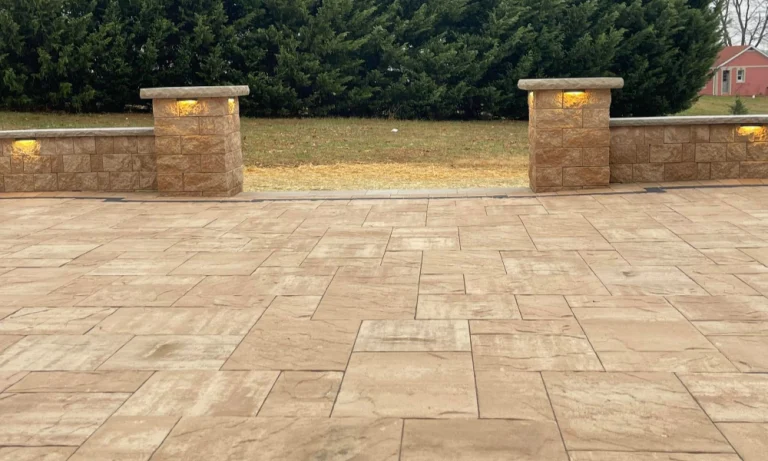
It also improves how the space looks. When drainage is handled correctly, the patio feels crisp and finished, especially when combined with features like landscape lighting, updated plantings, or a clean transition into a walkway or steps.
The most common causes of patio flooding in Harford County
Patio flooding usually comes down to one of a few root issues. The tricky part is that many patios have more than one problem at the same time. For example, a patio might have a poor pitch, plus a downspout dumping water near it, plus a yard that funnels runoff toward the house.
Below are the top causes we see most often, and what “fixing it the right way” looks like.
1. Incorrect pitch and grading
A patio needs a consistent slope so water moves off the surface instead of sitting in low spots. When patios are installed too flat, or worse, sloped toward the home, puddles are almost guaranteed. Even small elevation mistakes become obvious during a heavy rain, especially on properties with gentle backyard grades like we often see in Fallston and Forest Hill.
What to expect:
-
-
- Water collecting in the same areas every storm, especially near doors, steps, or the center of the patio
- Runoff flowing toward the foundation or into basement stairwells
- Wet, muddy edges where the surrounding yard is also graded incorrectly
-
Best use: Correcting pitch is essential when the patio itself is the problem, not just the yard around it. In many cases, this means lifting and resetting the surface, not “patching” it.
2. Missing or undersized drainage design
Many patios were built with no real drainage strategy. That is especially common with older concrete slabs and even some paver patios that were installed without considering how much runoff the space would receive. When water has nowhere to go, it finds the lowest point and stays there, something we often see in low pockets of yards in places like Abingdon and Churchville.
What to expect:
-
-
- Puddles that remain long after rain stops, even when the rest of the yard dries out
- Soil washout at patio edges, or mulch and stone pushed out of nearby beds
- Base failure beneath pavers, leading to sinking and uneven spots over time
-
Best use: This is where a real drainage solution makes the difference, such as a French drain, catch basin, trench drain, or a properly designed surface route that moves water to a safe discharge location.
3. Roof runoff and downspouts dumping near the patio
Sometimes the patio is not the main problem. The real issue is volume. If roof water is being discharged beside the patio, you are sending a lot of water into one small zone. That creates flooding, erosion, and saturated soil that cannot dry out between storms, which is a common setup we run into around patios and walkouts in Jarrettsville and Perry Hall.
What to expect:
-
-
- Overflow or splash zones near corners of the home where downspouts exit
- Washouts along the patio edge or under steps
- Water running across the patio surface during heavier storms
-
Best use: A downspout fix often needs to be tied into a larger drainage plan, because simply extending a pipe without grading and collection points can move the problem to another part of the yard.
Choosing the right solution depends on where the water is coming from, how it is moving across your property, and what the patio is built on. That is why diagnosis matters. Patio drainage is not a one-size-fits-all fix.
What “proper drainage” should look like
A patio that drains properly will not always be bone-dry in the middle of a downpour, but it should clear quickly once the rain stops. Water should move away from the home, away from edges that can erode, and away from areas that create constant saturation.
Here are realistic expectations we plan around:
-
- Consistent pitch: the patio surface needs a predictable slope, not random high and low spots
- Clear exit path: water needs a route off the patio to a safe area, not into a bed or against a foundation
- Base stability: the structure under the patio must support drainage without washing out or settling
- Edge containment: proper edging and transitions keep materials from migrating and protect the patio perimeter
This is also where the patio connects to the rest of the landscape. A patio can be “built right” and still flood if the yard dumps water into it. In those cases, correcting landscape grading, adjusting planting beds, or adding a surface channel can be just as important as the patio work itself.
Solutions that actually stop patio flooding
There are plenty of quick fixes people try, but most do not address the root issue. Adding sand, power washing, or re-leveling one small section often buys a little time, then the puddles return because the slope, base, or runoff source never changed.
Here are the solutions we use most often when the goal is “fix it for good.”
Regrading and drainage shaping: If water is naturally flowing toward the patio, we reshape the surrounding yard so runoff is guided away. This is often subtle work, but it needs to be deliberate and measured.
French drains and catch basins: When water needs a collection system, subsurface drains can intercept it before it reaches the patio. These systems only work when they are sloped correctly and discharged properly, which is why DIY installs often fail.
Trench drains near hard surfaces: When the patio is receiving sheet flow across the surface, a trench drain can capture it at the edge, keeping water from spreading across the pavers.
Permeable pavers in the right applications: A permeable paver patio can be a great solution when the site conditions make sense, because it lets water move through the surface and into a drainage base. It is not a magic fix for every yard, but when designed correctly it can dramatically reduce pooling.
Dry creek beds and visible drainage features: When water naturally wants to travel through a certain area, a dry creek bed can guide it in a controlled, attractive way, especially when paired with planting that stabilizes edges.
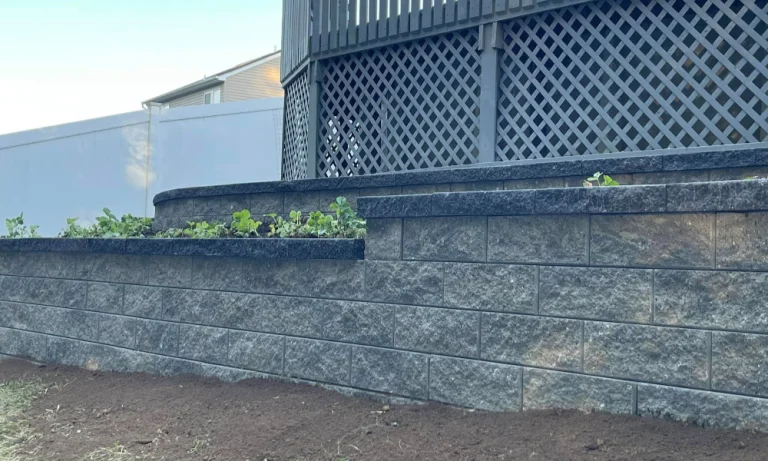
Many homeowners also take the opportunity to upgrade the space while the work is being done. For example, adding a seat wall, steps, or adjacent lighting can make the patio feel like a complete outdoor room, not just a surface that needed repair. This is where patio drainage ties naturally into larger hardscaping and landscape improvements.
Repair vs rebuild: what usually makes sense
Sometimes the fix is straightforward. Other times, the patio needs to be rebuilt because the foundation beneath it is wrong, the pitch is wrong, or both.
When a targeted repair can work
-
- Pooling is isolated to a small area and the base is still stable
- The overall pitch is correct, but there is one low spot from minor settling
- The drainage system exists, but needs improvement or reconfiguration
When a rebuild is the smarter long-term choice
-
- Puddling is widespread across the patio surface
- Pavers are settling, rocking, or separating in multiple areas
- The patio slopes toward the house or into a low point that cannot be drained properly
- The surrounding grade is wrong and the patio was built without accounting for runoff
If you are trying to budget realistically, it helps to review both the Landscape Pricing Guide and the Hardscape Pricing Guide. Patio flooding is almost never a “hardscape-only” issue. In many cases, the long-lasting fix involves both the patio structure and the landscape grading and drainage around it.
Mini case study: a patio that stopped pooling in Abingdon
A homeowner in Abingdon reached out because their patio stayed wet for days after storms. Water would collect near the back door and run toward the foundation. The patio surface also had subtle low spots that made puddles worse.
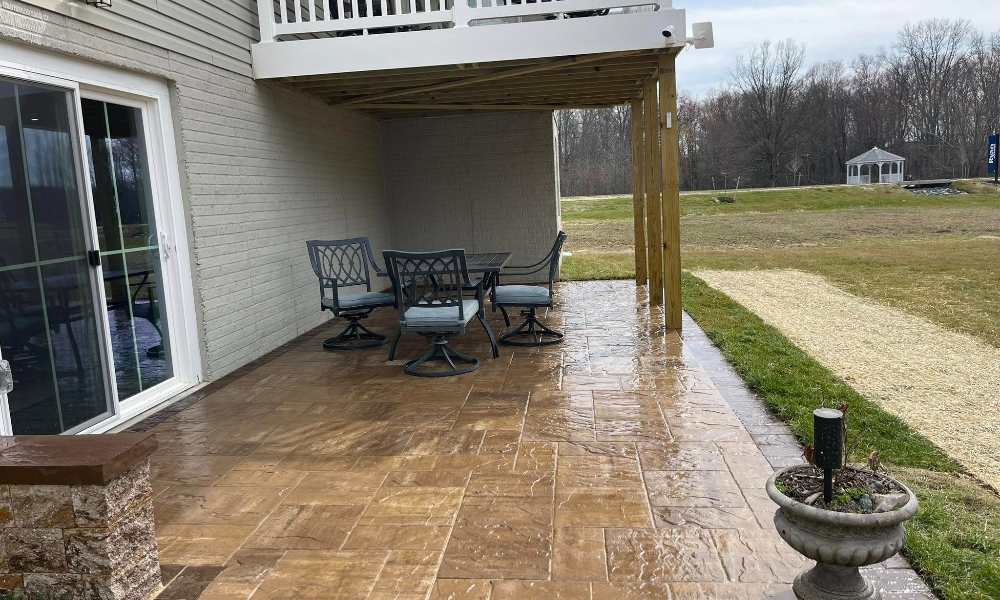
We evaluated the grade, identified the main runoff sources, then rebuilt the patio with proper pitch and a stable base. We integrated drainage to capture water at the edge and routed it to a safe discharge point away from the home. The homeowner also added simple landscape touches around the patio so the edges stayed clean and the space felt finished.
The result was a patio that dried quickly, stayed level, and became usable again after rain, instead of feeling like a constant problem area.
Proudly serving Harford County and beyond
Harvest Outdoor Living provides patio drainage corrections, patio construction, and outdoor upgrades in:
-
- Abingdon
- Aberdeen
- Bel Air
- Churchville
- Fallston
- Forest Hill
- Havre De Grace
- Jarrettsville
- Perry Hall
- White Marsh
- And surrounding Harford County areas
If you are unsure whether your property is within our service range, you can view the full list on our service area page.
Ready to stop patio flooding for good?
If your patio turns into a puddle every time it rains, let’s fix the cause, not just the symptoms.
Drainage problems are one of the easiest ways for a patio to fail early, and DIY “patches” rarely hold up through Maryland storms and freeze-thaw cycles. Our team will evaluate slope, runoff sources, base conditions, and drainage options, then recommend a plan that keeps your patio dry, stable, and built to last.
Request your estimate today and let’s make your patio usable again, even after heavy rain.